The simplified sister merger: fewer formalities and tax neutral
09/02/2026
Share this article


Mergers are often associated with complex procedures, administrative burdens and the mandatory involvement of various parties such as the notary, the auditor and the court registry. This perception is accurate in many cases, but did you know that not every type of merger is subject to the same level of formalities?
The legislator provides simplified merger procedures for companies that are closely connected. One of these is the simplified sister merger. Since the end of 2025, this merger form can also be carried out tax neutrally, just as has long been the case for the more well known silent (100%) parent subsidiary merger. As a result, the simplified sister merger has become a practically relevant tool, particularly in reorganisations within the same corporate group.
What do we mean by a sister merger?
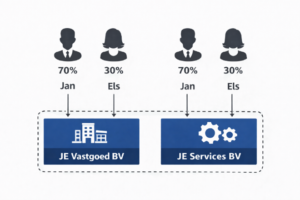
A sister merger occurs when two or more companies merge that share the same shareholder structure. The companies are not parent and subsidiary companies but are controlled by the same person or persons.
This is the case, for example, when a single shareholder owns multiple companies (figure 1) or when the same shareholders participate in different companies in identical proportions (figure 2).

The simplified procedure in practice
Just like a regular merger by absorption, a simplified sister merger starts with a draft merger proposal prepared by the management bodies of all companies involved. In addition, the legislation provides for several specific reports (from the board, statutory auditor or auditor), which may, however, be waived with the unanimous approval of all shareholders. After the six week waiting period has passed following the filing of the merger proposal with the registry of the enterprise court, the extraordinary general meeting can approve the merger. This decision is subsequently recorded in a notarial deed.
Some general practical points:
- Immovable property held by the absorbed company may entail additional obligations (e.g. soil certificate and/or asbestos certificate).
- Ongoing loans or financing often require prior approval from the bank (change of control clause).
- If personnel is involved, additional obligations apply under Collective Labour Agreement No. 32bis.
The essential difference compared to a classic merger lies in the elimination of a number of statutory obligations, resulting in significant time and cost savings:
- No mandatory issuance of new shares: the shareholder structure remains unchanged after the merger. This avoids additional formalities, such as the registration and updating of the share register of the acquiring company.
- No exchange ratio to calculate: in a standard merger, the exchange ratio must be determined to establish how many new shares will be granted to the shareholders of the absorbed company or companies. In a simplified sister merger, no new shares are issued, making this often complex and time consuming valuation exercise unnecessary.
- No audit report required: in a regular merger, a report by the statutory auditor or auditor is legally required in the context of the valuation of the contribution and the exchange ratio. In a simplified sister merger, this obligation is completely eliminated.
Now also tax neutral
Although the simplified sister merger has been legally possible since the introduction of the European Mobility Directive in 2023, it could not be carried out tax neutrally until recently (unlike the silent parent subsidiary merger). Due to a gap in tax legislation, there was a risk of additional taxation, which meant this merger form was rarely used in practice.
This uncertainty has now been resolved by the legislator: since 25 November 2025, a simplified sister merger can also take place tax neutrally, provided certain conditions are met and the shares of the merging companies are held directly by the same shareholder(s).
Conclusion
The simplified sister merger combines clear procedural advantages with the possibility, since the end of 2025, of restructuring in a tax neutral manner. This makes it an interesting tool for anyone wishing to simplify their corporate structure.
Our PKF BOFIDI Legal attorneys are ready to assist you
Not sure whether a simplified sister merger is suitable for your corporate structure? Contact our PKF BOFIDI Legal experts. They will guide you practically and efficiently in assessing and executing such a restructuring process.
This article was written by Michiel Coppens and Jasper Caby.